
Venus
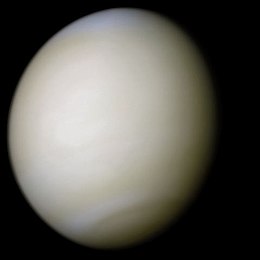
Venus is the second planet and the closest planet to Earth. It is the brightest planet when seen from Earth. Named after the Roman god of love, it is often referred to as Earth’s twin, as it has a similar size and internal structure. However, if you ever go to Venus, you’ll find that it is nothing like Earth. There, on the surface, the temperature is hot enough to melt lead, the air pressure is very high, acid rains down from the sky, and more.
Fun fact
Venus is one of the only two planets without a moon, along with Mercury
Venus orbits the sun from 108 million km (0.7AU) on average, making it the second closest planet to the sun. Although the distance varies, Venus is the closest planet to Earth, and at the nearest can be only 40 million km away. 1 year on Venus is 255 Earth days. It spins very slowly, taking 243 days to rotate 360 degrees and complete a sidereal day. However, one actual day (solar day) on Venus is only equal to 117 days on Earth, because Unlike other planets, Venus spins clockwise from east to west. Because it spins so slowly, by the time it spins less than half a full rotation, it has already orbited to face the sun again.
Venus is only 5% smaller than Earth, with a radius of 6000 km and a similarly sized a metallic core, a rocky mantle, and a crust. However, unlike Earth, the core does not generate a magnetic field, possibly because of the planet’s slow rotation and because of the lack of convection in the core, caused by how slowly the planet loses heat. Instead, Venus has a very weak induced magnetic field caused by charged particles in the atmosphere.
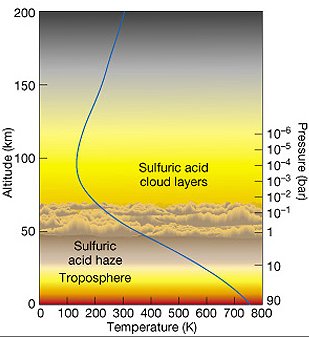
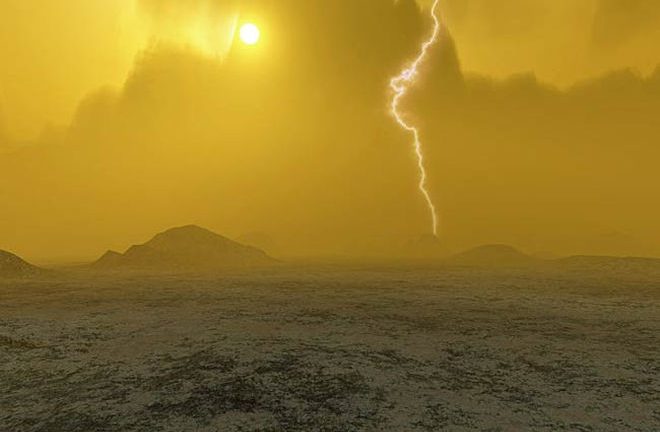
Venus has a very thick atmosphere. It is mostly made of carbon dioxide, and contains almost no water, as without a strong magnetic field, the lighter molecules get blown away by the solar wind. In the upper layers a few hundred km up, huge currents of air regularly reach speeds of over 360km/h, faster than the wind speeds in a hurricane. Here, the temperature is less than -170 C. as you descend, the wind slows down, and the temperature increases. Lower down, clouds of sulfuric acid can be seen. Highly charged by the solar radiation and fast winds, lightning streaks across the sky frequently. The air pressure also increases, with the weight of all the atmosphere above. By the time we drop below the cloud bottoms at 30 km up, the carbon dioxide atmosphere is so dense it is essentially a thick liquid.
The surface of Venus is perhaps the most inhospitable place in the solar system. Here, the temperature can be over 470 C, hot enough to melt lead, making it the hottest planet in the solar system. It is hotter than Mercury, even though it is over twice as far from the sun because its atmosphere traps heat in so swell. The air pressure is over 92 times that of Earth, the same as if you were a kilometer underwater. Acid rains down from the clouds above and the atmosphere above is so thick that everything looks like an orange haze. If you could ignore those hazards, On the surface, you would find mountains, valleys, highlands, plains, and more. The tallest mountain is Maxwell Montes, rising 11km above the normal elevation. There is also some strange features, such as ring-shaped coronas hundreds of km wide. You would only find a few, huge, craters, as any meteor hot big enough to cause that large of a crater would get burned up in the atmosphere. You would also find volcanoes everywhere, much bigger, more active, and more numerous than the number on Earth. This is because, without water, plate tectonics on Venus have stopped. Because of this, the crust is very old and weakened. The crust will continue to sit there until eventually, the magma underneath pushes through. In 1 period of high activity around 100 million years long, the entire old crust will be melted and replaced.
A popular theory is that billions of years ago, Venus might have had a much milder environment. However, because it was a bit closer to the sun, water started evaporating. This water vapor helped trap more heat in, causing more water to evaporate, and so on. This caused a runaway greenhouse effect that made the atmosphere like it is today.
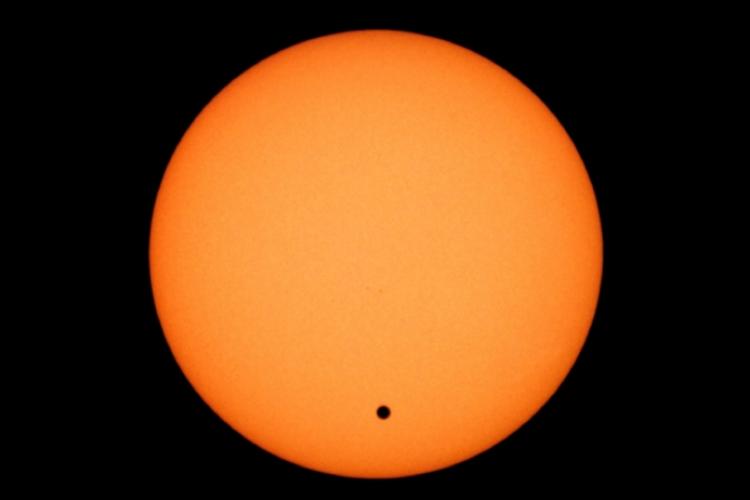
From Earth, Venus is the third brightest object in the sky, after the sun and moon. Not only is Venus relatively close, the tops of the clouds on Venus are very reflective. Because Venus is closer to the sun than Earth, it can only be seen at dawn and dusk. However, every hundred years or so, Venus passes between the Earth and the sun, kind of like the moon during a solar eclipse. This is called a transit. Although Venus is much too small and far to block the entire sun, the transits of Venus can be observed.
So far, we have sent many spacecraft to fly near Venus and collect information. A few have landed on its surface, but they worked for less than 2 hours before being destroyed by the harsh environment. Still, these spacecraft have provided valuable information about the surface and the soil.
Although the surface of Venus is certainly not suitable for humans, the area 50-60 km above might be more welcoming. Here, the temperature and pressure are similar to Earth. One idea for the future is to set up floating cities. Because carbon dioxide is denser than oxygen, regular air from Earth would be enough to keep the city afloat in Venus’s atmosphere. We would be protected from radiation by the atmosphere above, and even put the colony in an air current that circles the planet to simulate day and night. However, this is only a possibility, as we don’t have a laid out plan for the future, or the technology to carry it out. Even if we managed to make a floating colony on Venus, we would still have to deal with the acid clouds and the lightning, as well as many more unseen problems.