
Jupiter
Jupiter is the largest planet. Named after the Roman god of thunder, it is so large it has the volume of over a thousand Earths. The 5th planet from the sun has 69 moons, one of which is bigger than mercury. Unlike Earth and the other inner planets, Jupiter is a gas giant. This means that it is made of gas instead of rock. Storms and high-speed winds are scattered across the surface. The largest and most well-known one, the great red spot, is bigger than the entire Earth.
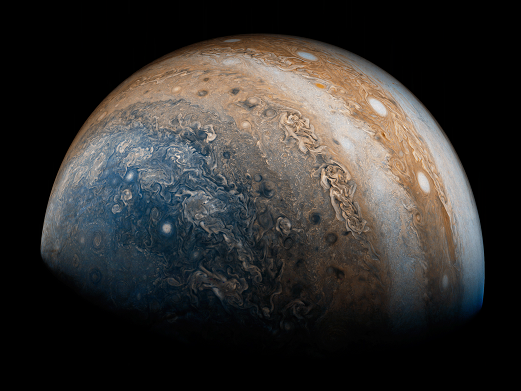
Jupiter is the fifth planet from the sun. it orbits at around 780 million km (5.2 AU), a big jump from Mars’s 1.5 AU orbit. Because it is so far, it is extremely cold, and each orbit takes 12 Earth years. It rotates once every 10 hours, which is especially fast when considering its great size.
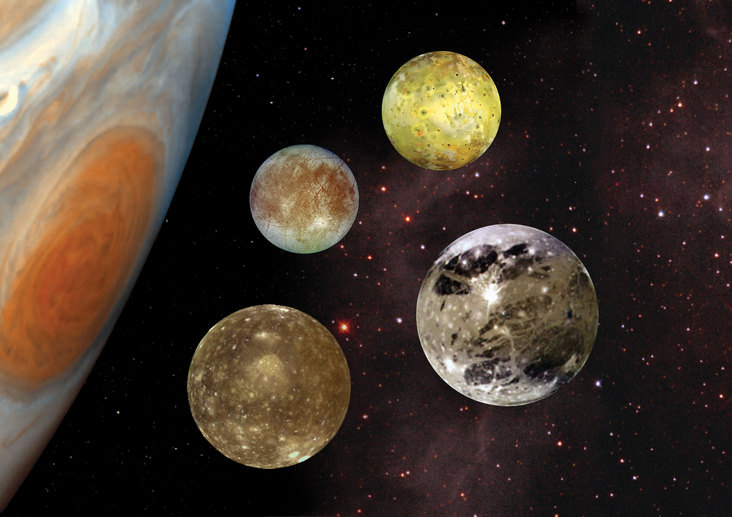
Jupiter has a radius of 70000 km and is about 11 times as wide as Earth. It is the biggest planet in the solar system and is more than twice as massive as all the other planets combined. It has over 60 moons. Four of them, Europa, Callisto, Ganymede, and Io, are some of the largest moons. Ganymede is the largest moon, even bigger than the smallest planet mercury. Europa and Callisto both might have huge underground oceans of liquid water. Because of tidal forces caused by Jupiter, Io is one of the most geologically active moons, with over 400 volcanoes. Jupiter also has rings, but unlike Saturn’s, they are very thin and hard to see.
Jupiter is mostly made of hydrogen and helium, the same composition as a star. In fact, if Jupiter became more massive, it would become a brown dwarf, and then eventually a red dwarf star. Although we are not sure of its internal composition, at the center of Jupiter there is believed to be a small, rocky core with about the mass of 15 Earths. This core is very dense and could have a temperature of over 50000 C. Early in the formation of the solar system, Jupiter could have started out as just that core before more and more gas started getting pulled to it.
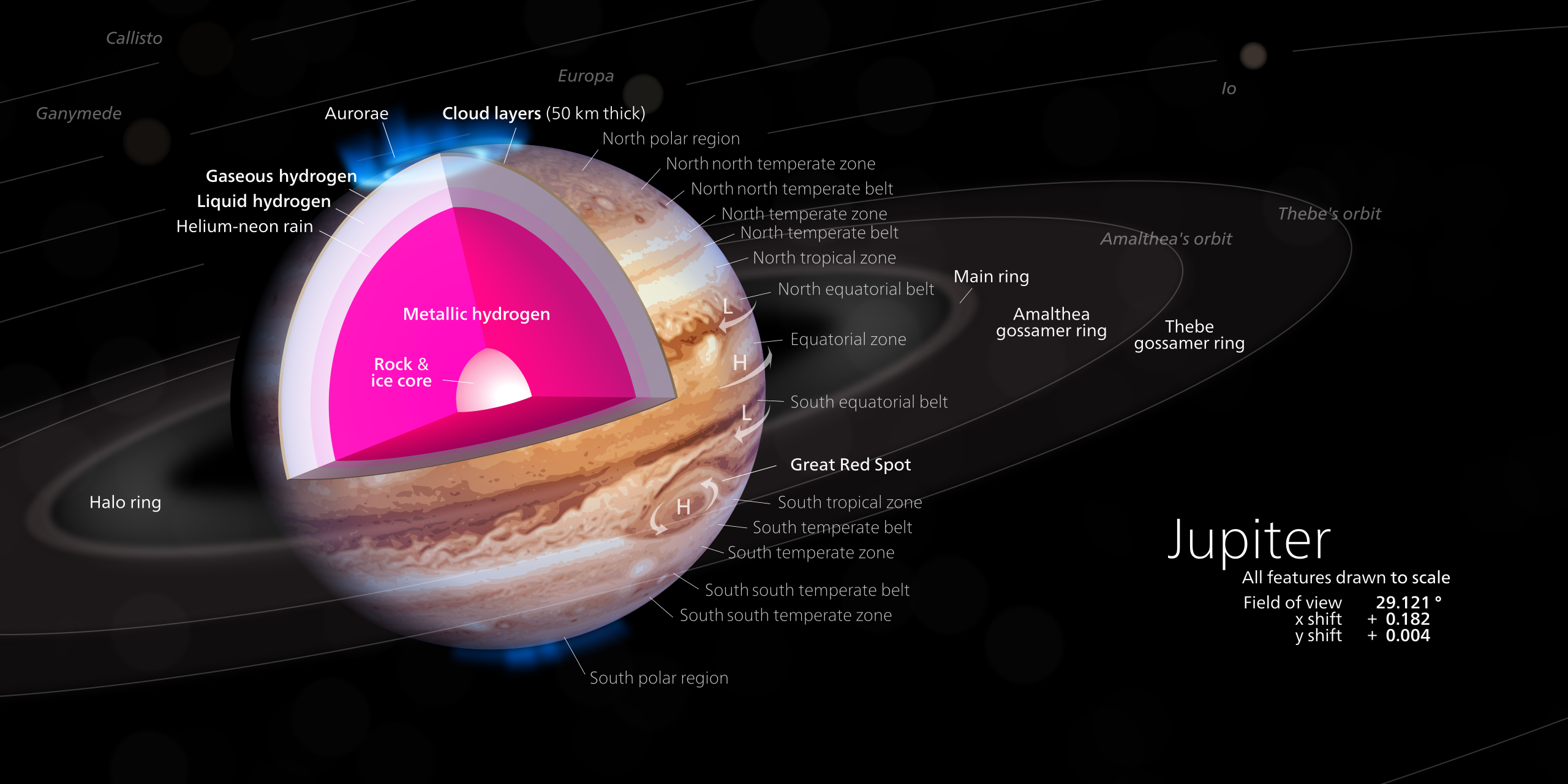
Surrounding the core is a layer of metallic hydrogen, hydrogen so dense and hot that it acts like an electrical conductor. This layer is liquid and extends until about 80% of the planet’s radius. This layer forms a very strong magnetic field, about 14 times as strong as Earth’s. it traps solar wind and creates huge auroras.
Because Jupiter is a gas giant, it has no real surface. Instead, the surface is just defined as the depth when the pressure reaches a certain point. Anything higher is considered the atmosphere. The top layer of Jupiter is just hydrogen getting denser as you go down, eventually going from a gas to a liquid and then becoming metallic.
The atmosphere of Jupiter is a very windy place. Here, there are many layers of clouds, with wind speeds of over 500 km/h. huge storms can be seen all over the planet, as ovals on the surface. The most famous and largest one is the great red spot, a swirling storm larger than Earth that has been going on for hundreds of years.