Uranus
Uranus is the seventh planet. Orbiting at 3 billion km (20 AU) from the sun, it is too far to see with the human eye. Because of this it was thought to be a star and was not discovered until 1781 when telescopes were used. Uranus was named after the Roman god of the sky.
Uranus completes 1 orbit every 84 years, and 1 rotation every 17 hours. However, unlike other planets, the rotational axis is tilted almost 90 degrees, and it spins sideways like a rolling ball. This means that every orbit, for about 21 years, the sun is directly over one of the planet’s poles, leaving the other hemisphere in the dark. Billions of years ago, when the solar system was forming, a planet may have crashed into Uranus, tilting it over.
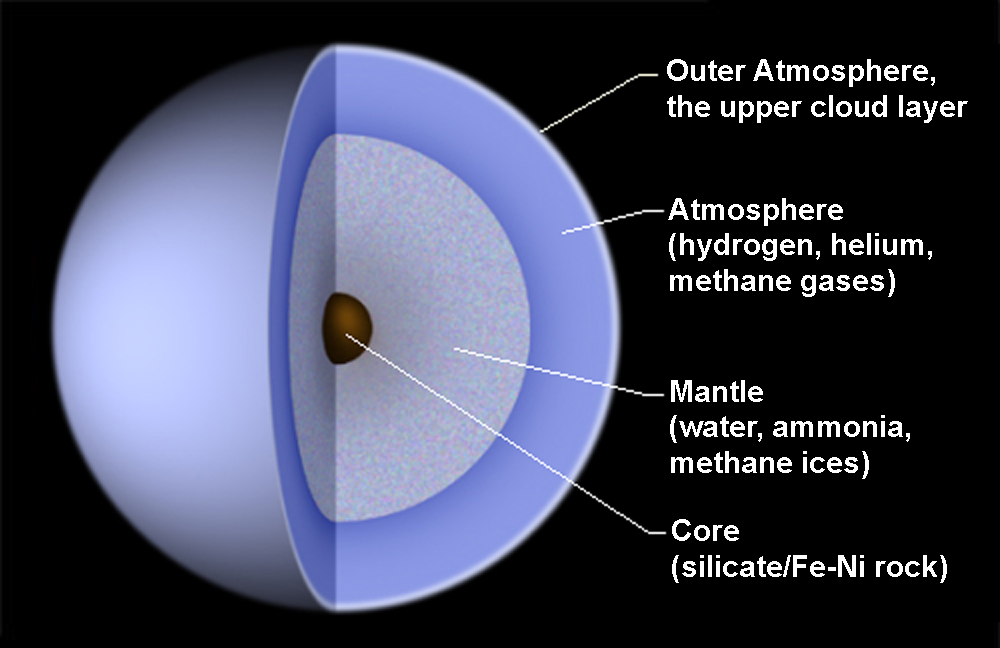
The radius of Uranus is about 25000 km, about 4 times that of Earth and 15 times the mass. It is slightly larger than Neptune but a bit lighter. Unlike Jupiter and Saturn, the Uranus is only partly made of gas, and most of the planet is made of ices. Because of this, Uranus and Neptune are a special type of gas giants called ice giants. Although the planets contain ices, they are not the type you would expect. when talking about planets, the word “ice” refers not just frozen water, but any elements or chemicals that have a low boiling point, such as oxygen, carbon dioxide, nitrogen, and hydrogen.
In the middle is a small rocky core with about half the mass of Earth and 5000 C hot. Surrounding that is a mantle, which makes up most of the planet and has the mass of 13 Earths. The mantle is a hot dense fluid made up of water, ammonia, methane, and other ices. Above that is a layer of gaseous hydrogen and helium. Although this layer has a total mass of less than half of Earth, makes up the top fifth of the planet’s radius.
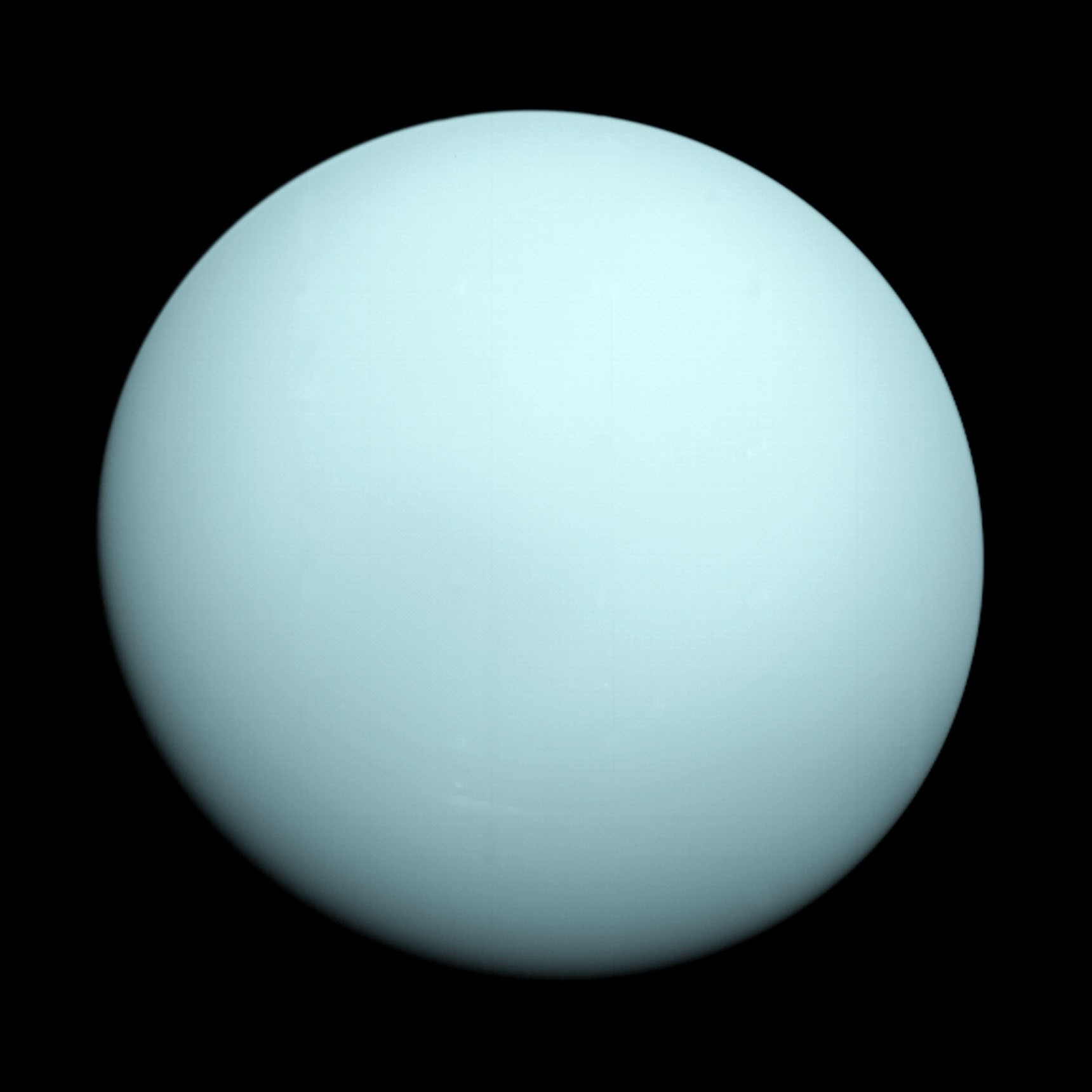
The surface of Uranus is a smooth blue-green color, caused by methane inside. Although the surface is plain with few features or clouds, there are huge winds with speeds over 900 km/h. the surface temperature can be as low as -230 C, even colder than on Neptune, because of the cooler interior.
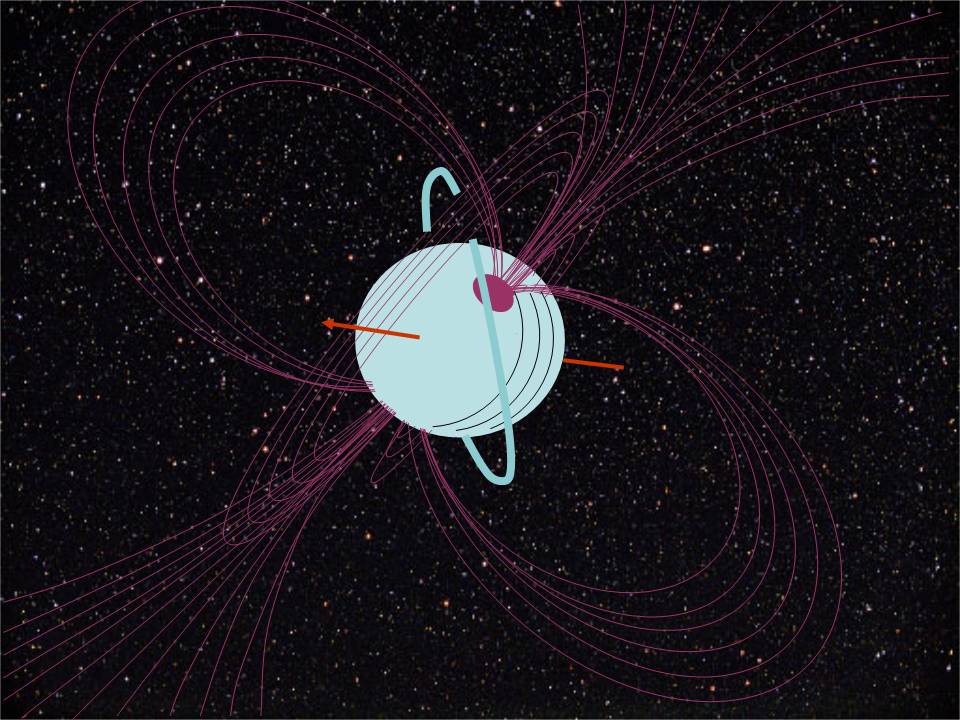
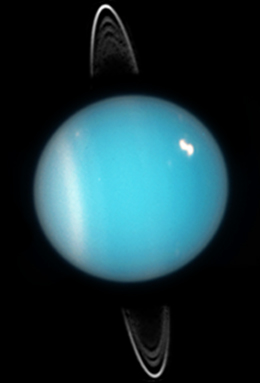
Uranus has 27 moons. It has rings, but they are very thin and almost invisible when seen from Earth. The magnetic field is very strange. Unlike most planets, the magnetic poles of Uranus are very far from the rotational poles and are caused by liquid close to the surface, rather than near the center. Because of the sideways rotation, the magnetic field is twisted as it extends into space.