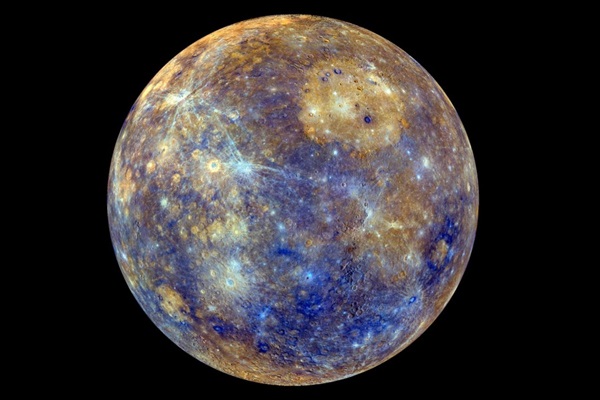
Mercury
The first planet is Mercury. Mercury is the closest planet to the sun, the fastest planet, and the smallest planet. Because it is so close, the temperature can get very hot. Although from space it looks like a boring rock, you can find countless unusual and exotic phenomenon on it.
Some more info
Mercury is the closest planet to the sun, with a highly elliptical orbit going from 46 million km (0.31 AU) to 70 million km (0.47 AU). Each orbit only takes a short distance to travel, and its orbital speed is faster than any other planet, at 50 km/s. Because of this, a year on Mercury lasts only 88 earth days! Because of how fast it is, it was named after the Roman god of speed, who was also called Mercury.
On the other hand, Mercury rotates very slowly, making 1 day on Mercury the same as almost 176 days on earth, over double the length of a year on Mercury.
Mercury is so close to the sun that if you were on Mercury, the sun would seem 3 times bigger. In the daytime, the surface of the planet is heated to over 430 C by the sun, making it the second hottest planet in the solar system. However, in the night the temperature plummets to a chilly -180 C.
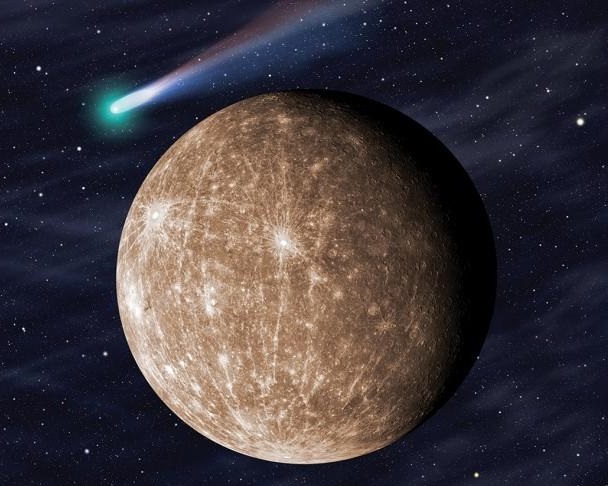
If Mercury gets so cold, why aren’t our nights on earth even colder? Unlike Earth, Mercury has an almost nonexistent atmosphere. Instead, it has an extremely thin layer of particles formed by solar wind, as well atoms picked off the surface by the solar wind and by meteoroids. This layer is quickly blown into space, forming a tail, almost like a comet.
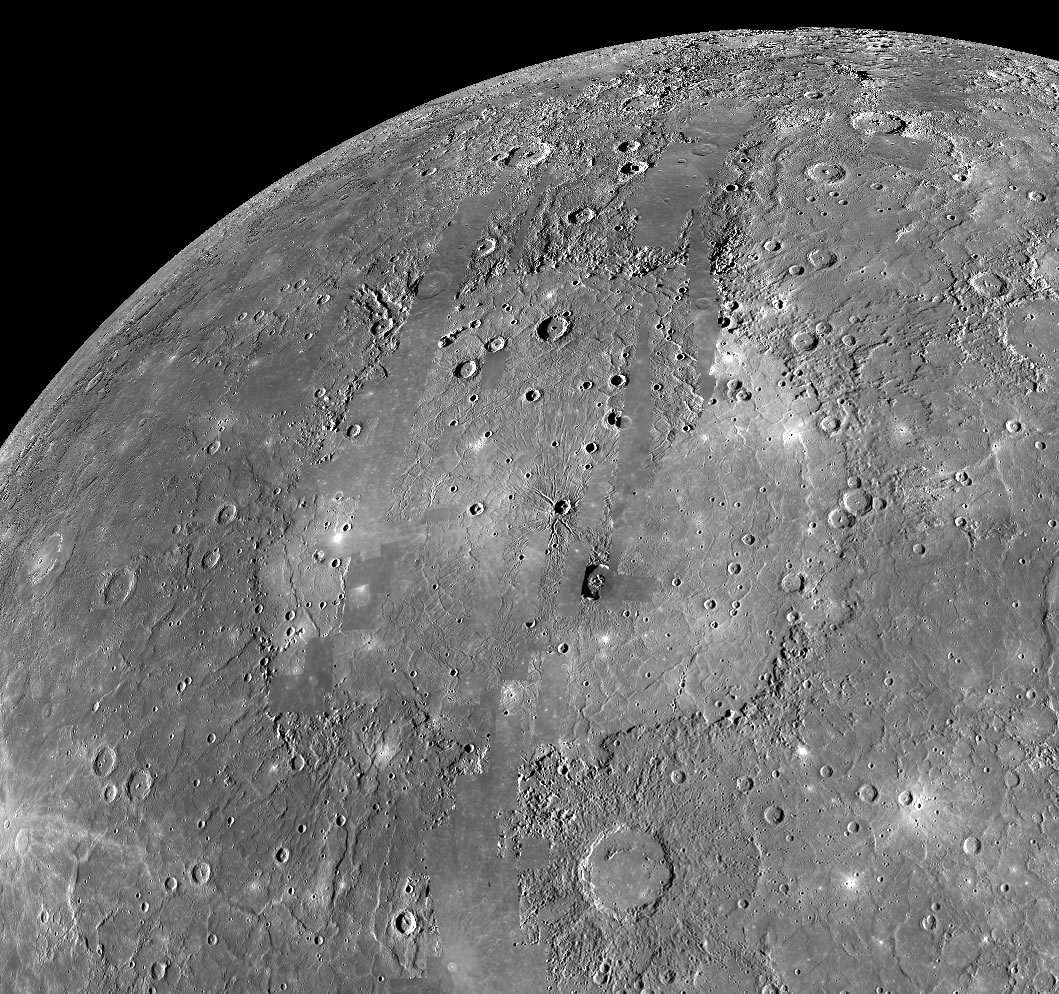
With no atmosphere to block meteoroids, the surface of the planet is covered with craters, much like the moon. Impact basins hundreds of km across still exist, formed by asteroid impacts billions of years ago. The biggest one, the Caloris basin, is over 1500 km across. The impact that had caused it was so powerful it caused volcanic eruptions, and material blasted into space traveled all the way around the planet to meet at the crater’s antipode, where they created an area called “weird terrain”.
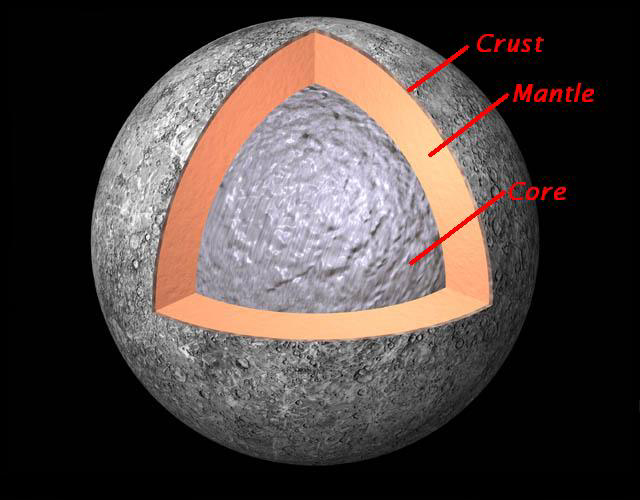
Mercury is the smallest planet in the solar system. With a radius of 2400km, it is almost a third of earth’s and smaller than some of Jupiter and Saturn’s moons. On the outside is the crust, a layer around 35km thick. Underneath is the mantle, a layer made of rock and silicon around 400km thick. In the center is a core made up of partly molten metal. For the planet’s small size, the core is unusually big, taking up over half of the volume and 70% of the mass. Although we are not sure why, one of the most popular theories is that early on, Mercury was originally a larger planet. The crust and a lot of the mantle were blown away when it collided with a smaller planetesimal a with a size of few thousand km, leaving a mostly the metallic core. This would also explain why Mercury is such a small planet.
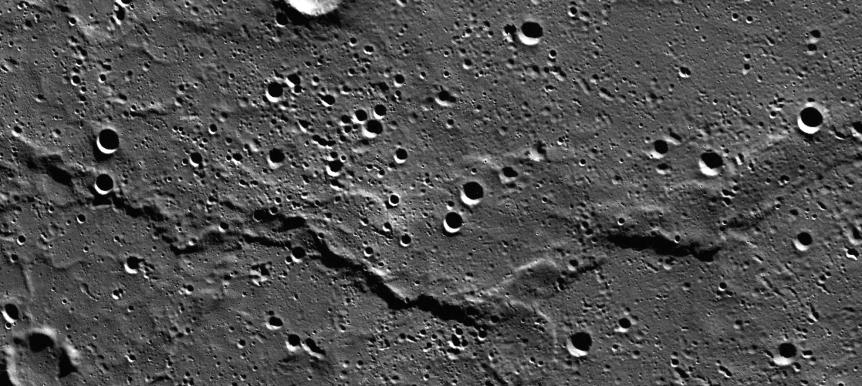
Although Mercury already is the smallest planet, it is still slowly shrinking. The mantle and core are cooling down, and as they do so, they start becoming smaller. However, the crust is solid, and can’t just shrink or expand, so as the core and mantle shrink, the crust collapses in on itself. This forms ridges that are hundreds of km wide and over 2 km high.
Because the core is liquid, Mercury has a magnetic field. Although only 1% as strong as earth’s, it is enough to interact with and deflect solar wind. Sometimes, this will form magnetic tornadoes hundreds of km wide that channel the solar wind onto the planet’s surface.
Because Mercury is so close to the sun, it is hard to look at using a telescope. Only during sunset or sunrise is it visible in our skies and not outshone by the sun. So far, only two spacecraft have been to Mercury: Mariner 10 and Messenger. Together, these 2 have mapped out most of the planet’s surface and provided tons of new info, from new terrain called the hollows to permanently shaded areas at the poles that are cold enough for ice.